
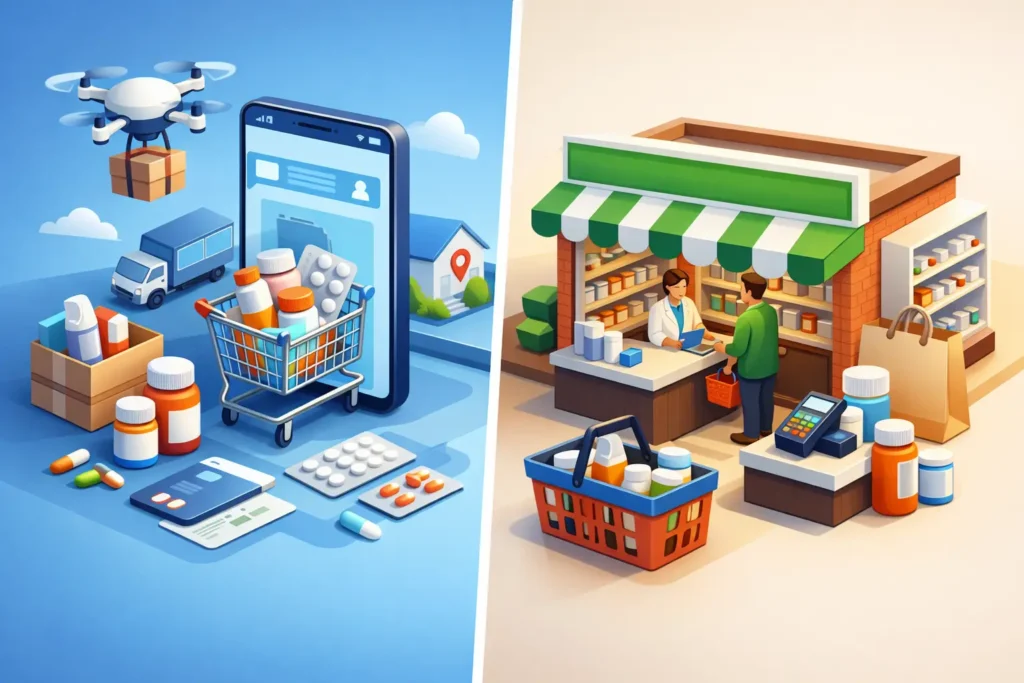
When a medicine is urgent, expensive, or hard to find, the choice between online pharmacy vs retail stops being a convenience question and becomes a treatment question. For many patients and caregivers, the real issue is not where buying feels easier. It is where you can reliably get the correct medicine, in the correct strength, with clear prescription handling and fewer delays.
That matters even more for specialty treatment. If you are managing transplant care, respiratory disease, pancreatic insufficiency, neurology, autoimmune conditions, or other long-term therapy, a missed refill can create real risk. In those cases, the difference between an online pharmacy and a walk-in retail store is often about access, authenticity, and continuity.
Online pharmacy vs retail: what actually changes?
A retail pharmacy gives you immediate face-to-face interaction. You walk in, ask for a product, confirm availability, and if the item is in stock, you leave with it the same day. That can be helpful for common medicines, basic OTC products, or urgent needs where speed matters more than selection.
An online pharmacy changes the process. Instead of depending on what a nearby shop keeps on the shelf, you search a larger catalog, review product details, upload a prescription if required, and place an order for delivery. This model is especially useful when the medicine is specialized, imported, sensitive, or difficult to source through general retail channels.
The best option depends on the medicine category, how often you buy it, and how easy or difficult it is to find locally. For everyday products, retail may still be practical. For recurring, specialty, or hard-to-find treatments, online often solves more problems than it creates.
Availability is often the biggest difference
Most local retail pharmacies are built around common demand. They usually stock antibiotics, pain relief, blood pressure medicines, vitamins, and popular chronic-care brands. That works well for general needs. It becomes less reliable when a patient needs a specific imported brand, a particular strength, a specialty injectable, or a medicine that is not regularly requested by the wider market.
This is where online channels often perform better. A specialized online pharmacy can build its catalog around treatments that are harder to source and maintain clearer product information for patients who search by brand name, molecule, dosage, or manufacturer. For caregivers trying to match a doctor’s prescription exactly, that level of specificity matters.
Retail stores may also require you to visit multiple outlets before finding the item you need. That is frustrating for any buyer, but even more so for someone managing a serious condition or purchasing on behalf of an elderly parent. Online ordering reduces that friction by letting you confirm stock, prescription status, and price before you commit.
Price is not always lower in one channel
Many people assume online will always be cheaper. That is not automatically true. Some retail pharmacies can offer good rates on fast-moving products, especially if they buy in bulk locally. At the same time, some online sellers may price specialty items more competitively because they serve focused demand and operate with a broader direct-to-consumer model.
The better way to compare price is to look beyond the sticker amount. Ask what you are getting for that cost. Is the medicine original imported stock? Is the strength exactly what your prescription requires? Are there delivery charges? Do you need to spend time and transport costs visiting multiple stores? If a retail pharmacy looks cheaper but cannot consistently supply the same product, the apparent saving may disappear quickly.
For patients on ongoing therapy, predictability is often more valuable than finding the lowest one-time price. A dependable source at a fair price can reduce treatment interruptions, emergency substitutions, and last-minute buying under pressure.
Prescription control and patient safety
For prescription-based medicines, a trustworthy online pharmacy should not feel casual. It should clearly state when a prescription is required and make the process straightforward but controlled. That is not a barrier. It is a sign that the pharmacy takes medicine handling seriously.
Retail pharmacies have an advantage in direct conversation. A patient can speak to staff immediately and clarify a dosage, alternative strength, or packaging question at the counter. That personal interaction can be useful, especially for first-time buyers. But safety in retail still depends on the standards of the individual store, the training of staff, and whether the medicine is available in its original, verifiable form.
Online pharmacies have a different strength. They can present product details in a consistent format before purchase, including brand, active ingredient, dosage form, strength, and prescription requirements. For treatment-aware patients who already know what they need, this can reduce confusion and support more accurate ordering.
Privacy can be a deciding factor
Not every medicine is easy to ask for at a public counter. Sexual wellness products, fertility-related medicines, oncology support, autoimmune treatment, and other sensitive therapies often come with privacy concerns. Some patients simply do not want to discuss these purchases in front of other customers or explain repeated refills to different staff members each month.
In this part of the online pharmacy vs retail comparison, online usually has a clear advantage. Patients can search privately, review the exact product, submit any required prescription, and receive delivery discreetly. That privacy is not only about comfort. It can improve adherence for people who might otherwise delay or avoid buying needed treatment.
For caregivers too, online ordering makes the process easier. A son, daughter, spouse, or sibling can place an order for a family member without the logistical strain of visiting several pharmacies in person.
Delivery and convenience are only part of the story
Convenience is often the first reason people mention when they discuss online medicine ordering, but for many patients it is actually the second or third benefit. The larger value is continuity. If a patient depends on recurring treatment, home delivery can reduce the chances of a missed refill caused by travel, stock hunting, work schedules, or mobility issues.
That said, delivery introduces timing questions. A retail pharmacy can be faster if the item is already in stock and needed the same day. Online works best when the buyer plans ahead, especially for chronic therapy. Responsible medicine buying still requires refill awareness. Ordering one or two days before the last dose is risky in any channel.
For patients outside major city centers, delivery can be more than a convenience feature. It can be the only practical route to accessing specialized medicines that local shops do not keep regularly. That is one reason services like OnlineDawai.pk can be valuable for patients who need original imported medicine with nationwide access and clear purchase information.
Authenticity matters more for specialty medicine
The higher the price and sensitivity of a medicine, the more important authenticity becomes. Patients buying transplant medicines, oncology support products, specialty injectables, or imported chronic-care brands are not just looking for availability. They need confidence that the product is genuine, properly handled, and supplied through a reliable channel.
A strong retail pharmacy can provide that, but not every neighborhood store is built for these categories. Some focus on fast-moving demand and may not consistently carry specialized imported products. A specialized online pharmacy can differentiate itself by centering its business on original imported medicines and making those product details visible from the start.
That visibility helps buyers make better decisions. If a listing clearly states the brand, strength, manufacturer, and prescription status, the customer has more confidence before payment and fewer surprises after delivery.
Which option works better for different needs?
If you need a common medicine immediately, a retail pharmacy is often the practical choice. If you need a specialized product, exact imported brand, or recurring prescription medicine that is difficult to source locally, online is usually better suited.
If privacy is a concern, online tends to be more comfortable. If you need in-person reassurance right away, retail may feel more familiar. If your treatment is expensive and long term, online can offer better continuity, easier product comparison, and less repeat effort month after month.
The channel is not the only question. The quality of the pharmacy matters more than the format. A reliable online pharmacy is better than an inconsistent retail store. A reputable retail pharmacy is better than an unclear online seller. Patients should judge both by product transparency, prescription discipline, availability, and trust.
What to check before you place an order
Whether you buy online or in-store, look for the same core signals. The product should match the prescription exactly. The pharmacy should clearly state whether a prescription is required. The brand and strength should be easy to verify. The seller should present medicine information in a way that reduces confusion, not adds to it.
For online orders, also check delivery expectations and whether the platform gives enough information to confirm product fit before purchase. For retail purchases, confirm stock and product details before making unnecessary trips, especially for medicines that are expensive or less commonly available.
The smartest choice is usually the one that helps you stay consistent with treatment, not the one that feels familiar for a single purchase. When access, authenticity, and refill reliability matter, choosing the right pharmacy channel can make your care easier to manage and much harder to interrupt.